
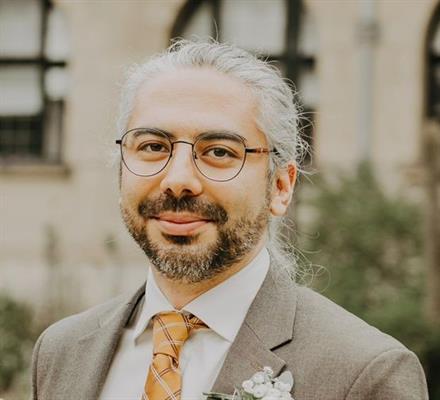
Dr Ramin Boroujerdi
- 01202 962676
- rboroujerdi at bournemouth dot ac dot uk
- http://orcid.org/0000-0001-7648-269X
- Lecturer in Toxicology
- Christchurch House C106, Talbot Campus, Fern Barrow, Poole, BH12 5BB
Biography
Dr Ramin Boroujerdi is a chemist and academic researcher specialising in analytical chemistry, nanomaterials chemistry, surface chemistry, spectroscopy and chemical sensor development. He is Programme Leader for the Science Foundation and Lecturer (Assistant Professor) in Toxicology in the School of Life and Environmental Sciences at Bournemouth University.
His research focuses on the design, synthesis and functionalisation of advanced nanomaterials for chemical and biological sensing, with particular emphasis on carbon-based nanomaterials, carbon quantum dots, nanocomposites and engineered nanoscale interfaces. His work integrates organic and materials chemistry with analytical chemistry and spectroscopy to develop sensitive and selective approaches for trace molecular detection.
A major focus of his current research is the development of carbon quantum dot-based composites and functional carbon nanomaterials for sensing pharmaceuticals, therapeutic drugs, drugs of abuse, environmental pollutants, food contaminants and biomarkers... Particular interest is placed on the relationship between nanomaterial structure, surface chemistry and analytical performance. By controlling surface functional groups, defects, heteroatom incorporation, electronic properties and molecular interactions, his research seeks to improve chemoselectivity, analyte affinity, preconcentration and signal generation.
Surface and interface chemistry is therefore central to his approach. His research investigates how engineered nanomaterial surfaces interact with target molecules and how these interactions can be exploited to improve sensitivity, selectivity, reproducibility and signal enhancement. This provides a materials-based approach to developing analytical platforms capable of detecting low concentrations of target species in chemically complex samples.
Spectroscopy forms a major component of his research, particularly Surface-Enhanced Raman Spectroscopy (SERS), Raman spectroscopy and fluorescence spectroscopy. His SERS work includes the development of functionalised carbon-based and hybrid nanomaterials, with interest in molecular adsorption, charge transfer, chemical enhancement and electromagnetic enhancement. In parallel, carbon quantum dots are investigated as fluorescent sensing materials, with emphasis on surface-state engineering, photoluminescence and interactions between nanomaterials and analytes.
His research is also concerned with practical analytical challenges associated with real samples. This includes matrix effects, interfering species, non-specific adsorption, analyte recovery and measurement reproducibility in biological fluids, wastewater, food and environmental samples. The broader aim is to develop sensing approaches that retain analytical performance beyond controlled laboratory solutions.
Before focusing primarily on carbon-based nanomaterials, Dr Boroujerdi also conducted research on one-dimensional semiconducting nanomaterials and two-dimensional graphene-based nanomaterials and nanoparticles. This work contributed to the development of a range of point-of-care sensing platforms using electrochemical, optical and spectroscopic techniques. This earlier experience continues to inform his current interest in integrating nanomaterial synthesis, surface chemistry and signal transduction for practical analytical sensing.
His broader research interests encompass pharmaceutical analysis, analytical toxicology, environmental monitoring, food and water safety, biomarker detection and portable analytical technologies. His long-term research programme centres on the rational design of chemically functionalised nanomaterials and molecular interfaces for selective trace detection, with scope to develop new materials, sensing mechanisms and analytical platforms across chemical, biomedical, environmental and toxicological applications.
moreResearch
Dr Ramin Boroujerdi's research lies at the interface of analytical chemistry, nanomaterials chemistry, surface chemistry and spectroscopy. His work is concerned with how the chemical and physical properties of engineered nanomaterials can be controlled to influence molecular recognition, analyte enrichment and signal transduction, with the ultimate aim of developing sensitive and selective chemical sensors.
His current research is particularly focused on carbon-based nanomaterials and carbon quantum dots, while his wider research experience includes one-dimensional semiconducting nanomaterials and two-dimensional graphene-based nanomaterials.
The main areas of his research include:
1. Carbon Nanomaterials and Carbon Quantum Dots: Synthesis, functionalisation and characterisation of carbon quantum dots, carbon nanodots and related carbon-based nanomaterials for analytical sensing. Research interests include precursor chemistry, nanoscale structure, defects, heteroatom incorporation, surface states, optical properties and chemical functionality.
2. Nanomaterial Surface and Interface Chemistry: Engineering nanomaterial surfaces to control molecular adsorption, analyte affinity, recognition, charge transfer and signal generation. Particular emphasis is placed on understanding structure-surface chemistry-function relationships and using surface functionalisation to improve chemoselectivity and analytical performance.
3. SERS and Raman-Based Sensing: Development of functional SERS substrates and hybrid nanocomposites for trace molecular detection... Research includes carbon-metal interfaces, plasmonic nanomaterials, molecular enrichment, electromagnetic and chemical enhancement, charge-transfer processes, selectivity and reproducibility.
4. Fluorescence and Optical Nanomaterial Sensors: Development of carbon quantum dot-based fluorescent sensors and optical probes. Research examines surface-dependent photoluminescence, fluorescence quenching and enhancement, electron and energy transfer, molecular interactions and strategies for selective detection.
5. Electrochemical and Multimodal Sensing: Earlier research included one-dimensional semiconducting and two-dimensional graphene-based nanomaterials for electrochemical and optical sensing. This work involved the development of point-of-care platforms and provided experience in combining nanomaterial properties with electrochemical, optical and spectroscopic signal transduction.
6. Trace Chemical and Bioanalytical Detection: Development of analytical methods for pharmaceuticals, therapeutic drugs, drugs of abuse, psychoactive substances, pollutants, food contaminants and biomarkers. A particular focus is detection at low concentrations in complex matrices, including biological fluids, wastewater, food and environmental samples.
7. Practical and Point-of-Care Sensor Development: Translation of nanomaterial-based sensing chemistry into portable and potentially point-of-care analytical technologies. Areas of interest include simplified sample preparation, miniaturised platforms, rapid analysis, multiplexed detection and integration of complementary sensing modalities.
Core expertise: analytical/bioanalytical, organic/materials chemistry, nanomaterial synthesis & functionalisation (CQDs, graphene, semiconductors, nanocomposites), surface/interfacial chemistry, SERS, fluorescence, optical and electrochemical sensing, chemical sensors, trace & complex-matrix analysis.
Applications: pharma/drug analysis, toxicology, environmental monitoring, food/water safety, biomedical analysis, biomarkers.
The overall research approach connects materials synthesis and surface chemistry with molecular interactions and analytical signal generation. This provides a flexible framework for developing new nanomaterials and sensing strategies as research opportunities emerge across analytical, biomedical, environmental, pharmaceutical and toxicological science.
moreJournal Articles
- Mahanty, S., Darbha, G.K., Paul, R., Boroujerdi, R., Valsami-Jones, E., Majumder, S., 2026. Green-Synthesized Iron Oxide-Chitosan Nanocomposite for Chromium and Nanoplastics Remediation. Bionanoscience, 16 (8).
- Paul, R., Ilankovan, V., Dray, J., Asamote, B., Cowling, L., Boroujerdi, R., Majumder, S., Dogan, H., 2025. Potential biomarkers of skin cancer diagnosis revealed through volatile metabolomics – A prospective research study. Ejc Skin Cancer, 3.
- Mahanty, S., Majumder, S., Paul, R., Boroujerdi, R., Valsami-Jones, E., Laforsch, C., 2024. A review on nanomaterial-based SERS substrates for sustainable agriculture. Science of the Total Environment, 950.
- Boroujerdi, R., Butt, A., Paul, R., Majumder, S., 2024. Unveiling Morphine: A Rapid and Selective Fluorescence Sensor for Forensic and Medical Analysis. Sensors, 24 (6).
- Boroujerdi, R., Paul, R., Abdelkader, A., 2022. Rapid Detection of Amitriptyline in Dried Blood and Dried Saliva Samples with Surface-Enhanced Raman Spectroscopy. Sensors, 22 (21).
- Boroujerdi, R., Abdelkader, A., Paul, R., 2022. Highly Sensitive and Selective Detection of the Antidepressant Amitriptyline Using a Functionalised Graphene-Based Sensor. Chemnanomat, 8 (10).
- Boroujerdi, R., Paul, R., 2022. Graphene-Based Electrochemical Sensors for Psychoactive Drugs. Nanomaterials, 12 (13).
- Boroujerdi, R., Abdelkader, A., Paul, R., 2022. Highly selective detection of ethanol in biological fluids and alcoholic drinks using indium ethylenediamine functionalized graphene. Sensors and Diagnostics, 1 (3), 566-578.
- Boroujerdi, R., Paul, R., 2022. Introducing Graphene–Indium Oxide Electrochemical Sensor for Detecting Ethanol in Aqueous Samples with CCD-RSM Optimization. Chemosensors, 10 (2).
- Boroujerdi, R., Abdelkader, A., Paul, R., 2020. State of the Art in Alcohol Sensing with 2D Materials. Nano Micro Letters, 12 (1).
- Paul, R., Tsanaclis, L., Murray, C., Boroujerdi, R., Facer, L., Corbin, A., 2019. Ethyl Glucuronide as a Long-term Alcohol Biomarker in Fingernail and Hair. Matrix Comparison and Evaluation of Gender Bias. Alcohol and Alcoholism, 54 (4), 402-407.
- Khani, R., Ghiamati, E., Boroujerdi, R., Rezaeifard, A., Zaryabi, M.H., 2016. A new and highly selective turn-on fluorescent sensor with fast response time for the monitoring of cadmium ions in cosmetic, and health product samples. Spectrochimica Acta Part A Molecular and Biomolecular Spectroscopy, 163, 120-126.
- Boroujerdi, R., 2016. Ce (III) - Porphyrin Sandwich Complex Ce2(TPP)3: A Rod-Like Nanoparticle as a Fluorescence Turn-Off Probe for Detection of Hg (II) and Cu (II). Journal of Fluorescence, 26 (3), 781-790.
- Ghiamati, E., Boroujerdi, R., 2016. Cd-Cysteine Nanorods as a Fluorescence Sensor for Determination of Fe (III) in Real Samples. Journal of Fluorescence, 26 (1), 135-147.
Reports
- Paul, R., Boroujerdi, R., Upson, S., Majumder, S., Rennie, S., 2025. Chemical profiling of ultra potent synthetic opioids.. Home Office.
Theses
- Boroujerdi, R., 2023. Printable graphene sensing systems for drug and alcohol detection. Bournemouth University, Faculty of Science and Technology.
PhD Students
- Victoria Louise Claydon. Evaluation of post mortem changes of skeletal remains and their correlation to DNA viability of Forensic Casework
- Caitlin Ann Budgen. Rapid On-Site Detection of Skin Cancer in Primary Care
- Gracie Elaine Needham. Pollution in Christchurch Harbour: A science-law-policy investigation of sources, impacts, and implications for environmental and public health
Profile of Teaching PG
- MRes Student - Taniya Vincent. Advanced Analytical Approaches for Detecting and Quantifying PFAS in Aquatic Systems
- MRes Student - Charli Rebecca O’Connor. Development and Validation of a Novel Deep Eutectic Solvent Microextraction Protocol for the Extraction of Nitazene Analogues in Dried Urine Spots
- MRes Student - Caitlin Budgen. Rapid On-Site Detection of Skin Cancer in Primary Care
Profile of Teaching UG
- Introduction to Toxicology - Unit Leader
- Chemistry - Unit Leader
- Forensic Research Skills - Teaching Team
- Independant Research Project - Student Supervision
- Professional Laboratory Practice - Teaching Team
- Exploring and Understanding Science - Teaching Team
- Foundation Year Project - Teaching Team
- Applied Sciences - Teaching Team
Grants
- Novel Synthetic Opioids (NSO) Training Aids (Home Office, 28 Sep 2026). Awarded
- Rapid on-site detection of skin cancer in primary care: Phase 2 (Cobham Trust, 02 Mar 2026). Awarded
- Design and Characterization of Functional Simulants of Novel Synthetic Opioids (Home Office, 02 Feb 2026). Awarded
- Volatile organic compounds as diagnostic biomarkers of skin cancer: follow-on funding (Charitable foundation, 30 Jan 2026). Awarded
- Chain Wax Composition Analysis (Muc-Off UK, 26 May 2025). Awarded
- Headspace profiling of synthetic opioids (Border Force, Home Office, 28 Oct 2024). Awarded
- Rapid On-Site Detection Of Skin Cancer In Primary Care (HEIF, Research England, 15 Apr 2024). Awarded
- Rapid on-site detection of skin cancer in primary care (The Valentine Charitable Trust, 06 Feb 2024). Awarded
- Rapid on-site detection of skin cancer in primary care (The Sir Samuel Scott of Yews Trust, 01 Feb 2024). Awarded
- Rapid on-site detection of skin cancer in primary care (kin Cancer Research Fund (SCaRF), 08 Jan 2024). Awarded
- Rapid on-site detection of skin cancer in primary care (Cobham Trust, 08 Jan 2024). Awarded
- Printable graphene sensing systems for drug and alcohol detection (SureScreen Diagnostics LtD, 17 Sep 2018). Awarded
Public Engagement & Outreach Activities
- 'From the Micro to the Nano World'. Bournemouth Natural Science Museum (Quekett Microscopy Society)
- Continuing Professional Development (CPD) Workshop
- NCSSM International Mentorship Program
- Analytical Chemistry Workshop
- Invited Research Presentation – Presidency University, Kolkata
- Invited Research Presentation – NIT Durgapur
Conference Presentations
- 11th Postgraduate Research Conference, 17 Oct 2019, Bournemouth University
- 7th Seminar of Chemistry and Environment, 26 Aug 2016, Baqiyatallah University of Medical Science
- 21th Iranian Analytical Chemistry Conference, 02 Feb 2015, Shahid Chamran University of Ahvaz
Qualifications
- PhD in Chemistry (Bournemouth University, 2023)
- FHEA in Higher Education (Advance HE, 2023)
- MSc in Analytical Chemistry (University of Birjand, 2015)
- BSc (Hons) in Applied Chemistry (Urmia University, 2013)
Honours
- Six-Times "You're Brilliant" Award Winner for Excellence in Toxicology Education (Students' Union at Bournemouth University, 2024)
- Teaching Innovation Award (Bournemouth University (FLIE), 2022)
- Five-Times "You're Brilliant" Award Winner for Excellence in Chemistry Education (Students' Union at Bournemouth University, 2026)
Memberships
- Iranian Chemical Society, Member,
- Society of Chemical Industry, Member,